THE COACHING ADVANTAGE: WHY SOME MANAGERS BUILD EXTRAORDINARY TEAMS
Related Article Page :
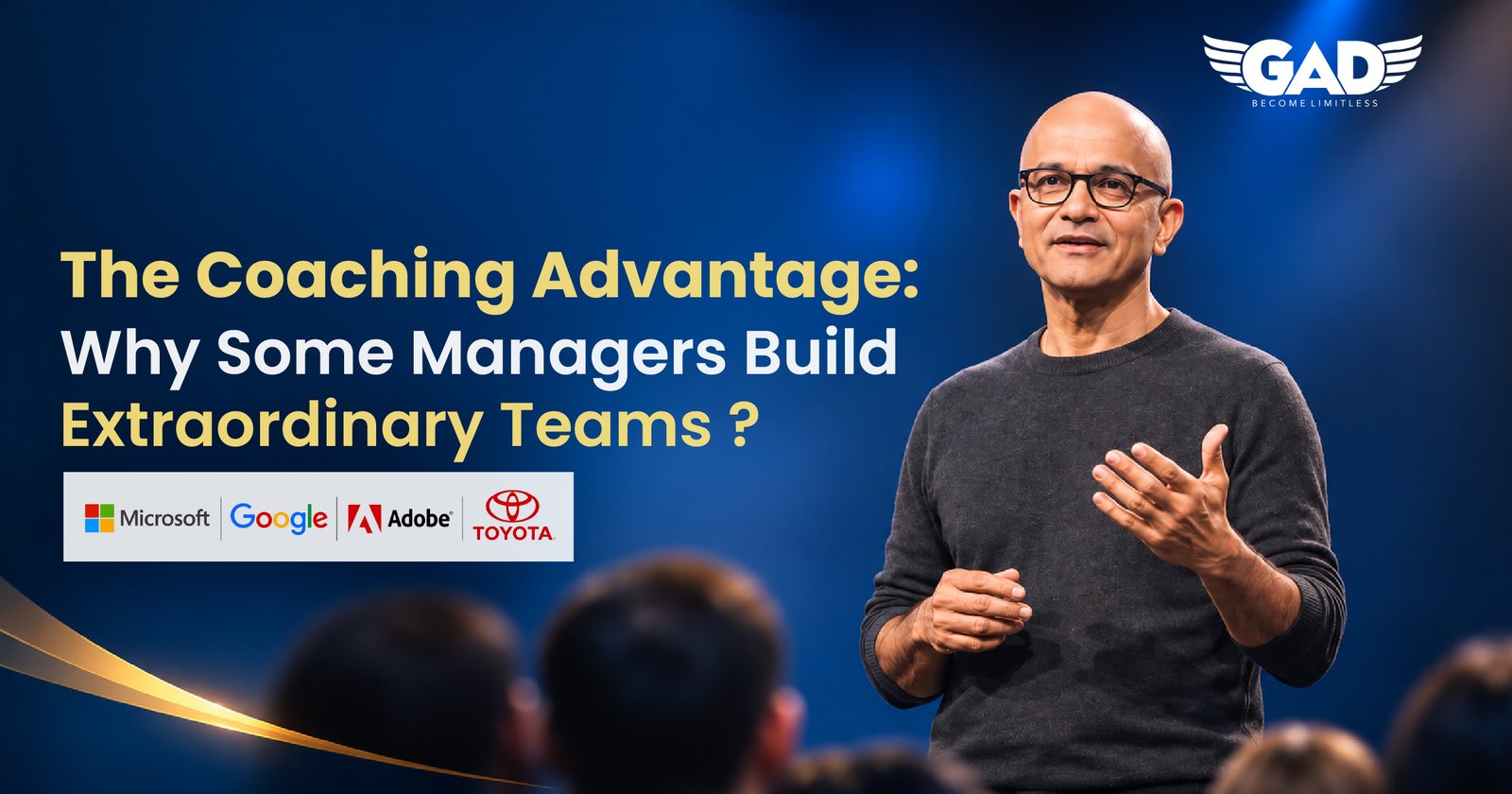


Why do some managers consistently develop extraordinary teams while others struggle despite having talented employees, sophisticated systems and substantial resources?
The difference is not always the quality of the people they recruit. Frequently, it is the quality of the leadership those people experience every day.
Consider the management philosophies associated with Microsoft, Google, Adobe and Toyota. These organisations operate in different industries, yet their approaches offer valuable lessons about continuous learning, effective managerial coaching, meaningful feedback and developing employees who can solve problems independently.
For CEOs and CHROs, the strategic question is not simply whether managers are achieving their targets. It is whether their leadership is continuously strengthening the organisation's human capability. Here are seven practices that can help managers become genuine performance multipliers.
When Satya Nadella became CEO of Microsoft in 2014, he emphasised a cultural shift from a know-it-all mindset towards a learn-it-all mindset.
The distinction challenged an important assumption about professional success. In highly technical organisations, expertise can become a source of status. Managers may feel pressure to demonstrate that they possess the best answers, while employees become reluctant to admit uncertainty or challenge established thinking.
A learning-oriented culture encourages curiosity, constructive questioning and continuous development.
For a coaching manager, this changes everyday conversations. Instead of immediately correcting an employee's recommendation, the manager might ask what alternatives were considered, what assumptions influenced the analysis and what additional perspectives could strengthen the decision.
The purpose is not to avoid giving answers when necessary. It is to encourage the thinking that produces better answers.
The strongest managers do not need to prove that they know everything. They develop teams that are capable of learning almost anything.
Microsoft's cultural transformation illustrates why a learning mindset matters when organisations must continually adapt to technological and competitive change.
Google's Project Oxygen examined the behaviours associated with effective management. Among the practices it identified, being a good coach became one of the most prominent.
This is significant because coaching is often treated as an optional leadership quality rather than a fundamental managerial responsibility.
Google's research highlighted the importance of providing actionable feedback, supporting employee development, empowering teams and avoiding unnecessary micromanagement.
Consider a software engineering manager whose team repeatedly misses development milestones. A traditional response might involve increasing supervision, demanding additional reporting and personally resolving technical difficulties.
A coaching-oriented manager would also examine the underlying causes. Are priorities clear? Do engineers possess the required capabilities? Are dependencies being identified early? What decisions could the team make independently?
These conversations help employees strengthen judgement and execution capability rather than merely comply with additional instructions.
A manager's effectiveness should not be judged only by the problems they solve, but also by the problems their people become capable of solving.
Google's findings reinforce the importance of treating coaching as a measurable managerial behaviour.
In 2012, Adobe introduced its Check-in approach, moving away from traditional annual performance reviews towards more frequent conversations about expectations, feedback and employee development.
The underlying lesson is important: meaningful performance improvement cannot depend entirely on a conversation that happens once or twice a year.
Imagine a sales executive who repeatedly struggles to handle customer objections. If the manager waits until the annual appraisal to address the issue, valuable opportunities for improvement may be lost.
A coaching-oriented manager observes actual sales interactions, discusses what worked, identifies ineffective approaches and helps the employee prepare for the next customer conversation.
The employee receives feedback while the experience is still relevant.
Over time, this creates a continuous cycle of observation, reflection, improvement and application.
Adobe's approach demonstrates how organisations can place developmental conversations closer to everyday performance.
Toyota's management philosophy is strongly associated with continuous improvement, employee involvement and structured problem-solving.
Practices such as kaizen encourage employees to identify operational problems, investigate causes and contribute to improvement.
Toyota Kata, a coaching approach developed from research into Toyota's management routines, further illustrates the value of practising systematic problem-solving through repeated coaching cycles.
Consider a manufacturing supervisor whose production line experiences recurring quality defects. The supervisor could personally diagnose every issue and instruct employees on corrective action.
Alternatively, the supervisor could guide employees to identify the actual condition, define the desired condition, examine obstacles and test appropriate improvements.
The immediate problem still matters, but the developmental objective becomes equally important.
The greatest value of solving a problem is not always the solution itself. It may be the capability developed in the people who solved it.
For high-growth organisations, this distinction is essential. Teams must become progressively more capable rather than permanently dependent on managerial expertise.
Intel's use of Objectives and Key Results, developed under Andy Grove, helped establish a disciplined approach to connecting ambitious objectives with measurable outcomes.
Although OKRs are not a coaching methodology, they offer an important lesson for performance-oriented coaching: developmental conversations should remain connected to business priorities.
Consider a customer service manager responsible for improving customer satisfaction. A general conversation about communication skills may be useful, but it becomes considerably more powerful when linked to actual customer interactions, complaint-resolution quality and measurable service improvements.
The manager can coach employees to identify specific behaviours influencing outcomes, establish improvement commitments and review progress.
This creates a direct relationship between employee development and organisational performance.
Coaching should not become an activity separate from business results. It should strengthen the capabilities that produce those results.
The combination of clear objectives, meaningful feedback and developmental support helps managers maintain both performance discipline and employee growth.
Google's Project Aristotle examined factors associated with effective teams and highlighted psychological safety as particularly important.
Psychological safety enables employees to raise concerns, ask questions, acknowledge mistakes and contribute ideas without unnecessary fear of embarrassment or humiliation.
For coaching managers, this matters because meaningful development requires honest conversations about uncertainty, weaknesses and mistakes.
Imagine a project team that misses an important customer commitment. A blame-driven manager may criticise individuals publicly, encouraging employees to conceal future problems.
An overly permissive manager may avoid confronting the performance failure altogether.
A coaching-oriented manager takes a different approach. The team examines what happened, identifies the causes, accepts responsibility and agrees on corrective action.
The discussion is direct but constructive.
Coaching is therefore not about lowering expectations. It is about creating an environment where people can learn quickly while remaining responsible for results.
General Electric historically placed considerable emphasis on developing management and leadership capability, including through its Crotonville leadership development centre.
Although formal leadership development is broader than coaching, GE's historical investment illustrates the importance of treating leadership development as an organisational responsibility.
Consider two business heads who deliver similar financial results.
The first achieves performance through personal intervention and constant supervision. The second achieves comparable results while deliberately preparing team members for larger responsibilities through coaching, challenging assignments and progressive delegation.
When both executives move into larger roles, the second leaves behind a stronger leadership pipeline.
This is the deeper value of coaching-oriented management.
Managers should be evaluated not only through revenue, profitability and productivity, but also through the capability they develop in others.
The ultimate achievement of a coaching manager is not creating employees who remain dependent on them. It is developing leaders who can eventually exceed them.
These organisations do not all use identical management systems, and their business results cannot be attributed to coaching alone. However, their practices reveal a consistent principle: developing people must become part of how organisations manage performance, not an occasional activity delegated to HR.
A coaching manager strengthens critical thinking, encourages ownership, provides continuous feedback, develops independent problem-solvers and creates the conditions for sustained performance.
For CEOs and CHROs, this raises an important question: Are your managers merely delivering this quarter's results, or are they developing the capability required to deliver stronger results for years to come?
A great manager can achieve extraordinary results through personal effort. A great coaching manager builds people who can achieve extraordinary results together.

Why the most helpful managers can unintentionally become the biggest barrier to team development. Discover seven coaching strategies to move from providing answers to multiplying capability.
Read More
A business does not become slow because it has too many decisions to make. It becomes slow when too many decisions are waiting for someone else to make them. Here are seven strategies to build independent leaders.
Read More
The capabilities that make you a successful manager today may not be the capabilities that make you an extraordinary leader in 2030. Here are five leadership capabilities that deserve immediate attention.
Read More