THE SUCCESSION ILLUSION: HAVING A SUCCESSOR IS NOT THE SAME AS HAVING A FUTURE LEADER
Related Article Page :
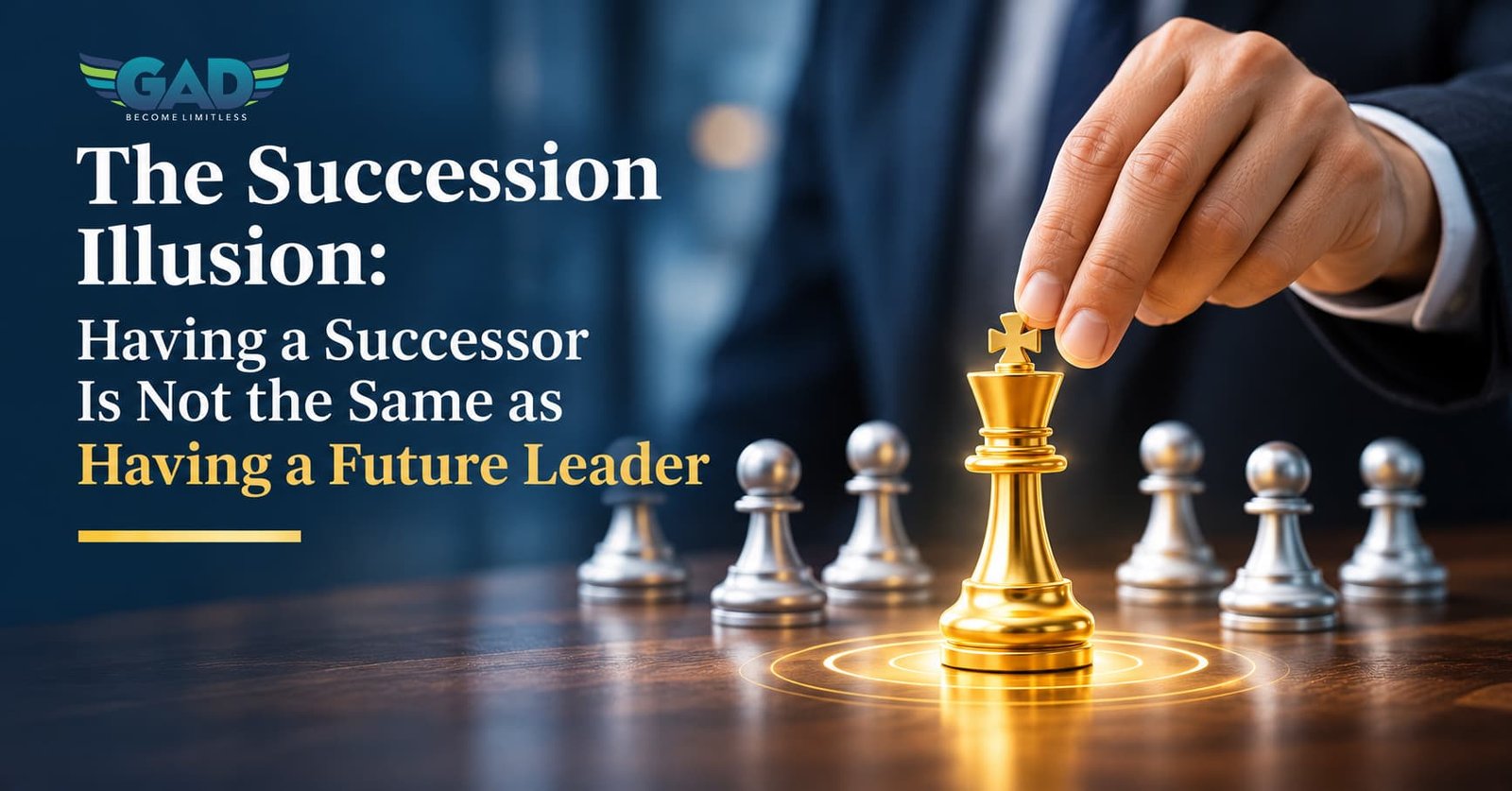


Imagine a ₹2,000 crore manufacturing company preparing for the retirement of its long-serving business head. The board has identified a successor, HR has completed its talent review and the candidate has consistently delivered strong results for several years. On paper, the organisation appears well prepared.
But six months after the leadership transition, critical business decisions begin slowing down. The new leader struggles to manage competing priorities, senior executives disagree over strategic direction and important customer relationships become increasingly dependent on intervention from the outgoing leader.
The organisation had identified a replacement. It had not sufficiently developed a leader capable of running the business. This is the succession illusion.
Across industries, organisations invest considerable effort in identifying high-potential employees and preparing succession charts. Yet a name against a critical position is not proof of leadership readiness. It merely indicates that someone has been considered for the role.
The real challenge is developing leaders who can handle the complexity, uncertainty, commercial responsibility and organisational influence that future leadership demands. For CEOs, CHROs and boards, succession planning must therefore move beyond replacement identification towards systematic leadership capability development.
One of the most common succession mistakes is assuming that an exceptional performer will automatically become an exceptional leader.
Consider a regional sales head who consistently exceeds revenue targets, maintains excellent customer relationships and demonstrates outstanding commercial discipline. The organisation identifies this individual as a future business head.
However, managing an entire business requires capabilities beyond sales excellence. The role demands financial judgement, operational understanding, strategic foresight, cross-functional leadership and the ability to balance competing business priorities. Without developing these capabilities, the organisation may promote someone who is outstanding in one function but unprepared for enterprise leadership.
Performance demonstrates what an individual has achieved in the current role. Leadership potential indicates the capacity to succeed in a significantly more complex future role.
Succession decisions must assess both dimensions independently.
Businesses evolve faster than many succession plans. A company that currently operates primarily in domestic markets may be preparing for international expansion. A traditional manufacturing business may be investing in automation, digital transformation or entirely new revenue models.
The capabilities required to lead the next phase may be fundamentally different from those that made the current leader successful. Consider a family-owned business preparing its next-generation leader. The incumbent may have built the organisation through personal relationships, entrepreneurial instinct and close operational control.
The successor may need to build institutional governance, professional management systems, international partnerships and scalable operating structures. Simply teaching the successor to imitate the incumbent could preserve the very limitations the business needs to overcome.
The purpose of succession planning is not to reproduce yesterday's leadership. It is to develop the leadership required for tomorrow's business.
This demands future-oriented competency mapping and a clear understanding of the organisation's strategic direction.
Succession decisions are frequently influenced by tenure, loyalty, visibility and the confidence of senior leaders. These factors may provide useful information, but they are insufficient indicators of future leadership readiness. A credible succession process should evaluate strategic thinking, decision-making, business judgement, emotional maturity, execution discipline, people leadership and the ability to operate under uncertainty.
Consider two candidates for a plant head position. The first is highly experienced and respected but has primarily managed stable operations. The second has less tenure but has successfully led a difficult turnaround, improved cross-functional coordination and demonstrated stronger decision-making under pressure. Selecting the first candidate solely because of seniority may overlook important evidence of future readiness.
Organisations should therefore combine structured leadership assessments, behavioural evidence, performance history, stakeholder feedback and demonstrated capability in demanding assignments.
Leadership capability cannot be developed entirely through classroom programmes, assessment reports or mentoring conversations. Future leaders must experience the responsibilities they are expected to assume.
Imagine a potential business head who has never managed a profit-and-loss statement, negotiated a strategic partnership or made a difficult decision involving multiple functions. The candidate may possess strong theoretical knowledge but lack the judgement developed through real commercial responsibility.
An effective succession programme creates deliberate opportunities for emerging leaders to manage complex projects, lead cross-functional initiatives, participate in strategic reviews and make consequential decisions within appropriate boundaries. These assignments should be supported by executive coaching, structured feedback and regular readiness reviews.
For example, a potential plant head might be assigned responsibility for improving operational efficiency across multiple facilities rather than remaining confined to one department.
A successor becomes ready not simply by learning about leadership, but by repeatedly demonstrating leadership in increasingly demanding situations.
One of the most overlooked barriers to successful succession is the behaviour of the current leader. Many leaders genuinely want capable successors but struggle to transfer authority, share critical relationships or allow emerging leaders to make independent decisions. The incumbent may continue approving every major proposal, intervening in customer negotiations and personally resolving complex organisational issues.
The successor receives the title of future leader without the experience of exercising genuine leadership.
Consider a founder who identifies a family member as the next CEO but continues to control all major financial, commercial and personnel decisions. The successor may remain dependent despite years of preparation. Effective succession requires incumbents to become deliberate developers of future leaders. They must transfer knowledge, provide exposure, delegate meaningful authority and allow successors to experience the consequences of responsible decisions.
Succession readiness depends not only on the successor's willingness to lead, but also on the incumbent's willingness to let leadership evolve.
A succession plan should not be considered successful simply because a candidate has completed a development programme. Organisations must test whether the individual can perform the responsibilities of the future role. This can involve temporary leadership assignments, strategic business simulations, cross-functional responsibilities, crisis-management exercises and structured business reviews.
Imagine a company preparing a successor for its chief operating officer. Rather than relying exclusively on assessments, the organisation assigns the candidate responsibility for leading a major operational transformation across several locations. The assignment reveals how the individual handles resistance, allocates resources, manages competing priorities and delivers measurable outcomes. The results provide stronger evidence of readiness than a favourable succession rating alone.
Boards and CEOs should also distinguish between candidates who are ready immediately, those who require further development and those whose readiness remains uncertain.
A mature succession strategy should not depend on identifying one individual for each critical position. Organisations need a broader pipeline of leaders with different strengths, experiences and future-role possibilities. Consider a rapidly expanding enterprise planning to establish three new business units over the next five years. Identifying a successor for the current CEO will not address the need for additional business heads, functional leaders and transformation executives.
The organisation must systematically develop leadership capacity across multiple levels. This requires identifying critical future roles, assessing leadership potential, providing differentiated development and reviewing readiness as business priorities evolve. It also requires measuring the effectiveness of the succession system itself: the depth of the leadership bench, readiness for critical positions, internal mobility and performance following leadership transitions.
A replacement plan protects an individual position. A leadership pipeline protects the future of the enterprise.
Imagine your CEO or most important business leader leaving tomorrow.
Does your organisation have someone who can occupy the position, or someone who can genuinely lead the business? Can that individual make difficult decisions, command stakeholder confidence, manage commercial complexity and deliver results without depending on the outgoing leader?
If the answer remains uncertain, the organisation may have a succession chart, but it does not yet have succession readiness. For boards, CEOs and CHROs, the responsibility is clear. Succession planning must become a continuous process of identifying, assessing, developing, testing and preparing future leaders.
The success of succession planning is not measured by how many successors have been identified. It is measured by how many leaders are genuinely ready to take the organisation forward.
Because the ultimate responsibility of leadership is not merely to build a successful business today.

Why extraordinary business results require more than extraordinary pressure. Discover seven leadership principles to build sustainable execution, capability, and accountability.
Read More
Explore how businesses can scale towards ₹1,000 crore by strengthening leadership capability, succession planning, and strategic decision-making.
Read More
Managing people is about ensuring that work gets done. Coaching people is about increasing their capability to deliver exceptional results. Explore 7 leadership practices that transform managers into performance multipliers.
Read More